
 RSS Feed (xml)
Sunday, December 3, 2006
Keep a good selection of earrings on hand to meet all your fashion needs
It’s amazing what a pair of earrings can do to your look! Earrings are the most important wardrobe accessory you can own. You’ll get great value from your earrings. Choose earrings that meet your life style, your personality, and your tastes. There is no point in buying a pair of trendy earrings that you’ll never wear because they don’t feel like "you".Earrings also make a great jewelry gift as

Friday, September 22, 2006
Silhouettes
 “Shades are the truest representation that can be given of man” – Johann Lavater, 1804
Shades, the old name given to silhouettes, became popular after about 1760 and were an outgrowth of the neoclassical revival. Silhouette artists were extremely influenced by both Johann Lavater and classical Greek art. Lavater, the father of the pseudo-science of physiognomy, believed that one’s internal qualities, emotions, intellect, capacity for achievement, and so forth, could be read from a profile of the face especially as a shade. Essentially physiognomy was the “science” of judging a book by its cover, but it was very popular with the producers and consumers of silhouettes. Ancient Greek black figure vases and red figure vases provided additional sources of inspiration and study for artists. For example, both Charles Rosenberg and Jacob Spornberg produced silhouettes in imitation of these silhouette-like vases. Silhouettes were produced on a variety of media including paper, plaster, and ivory.
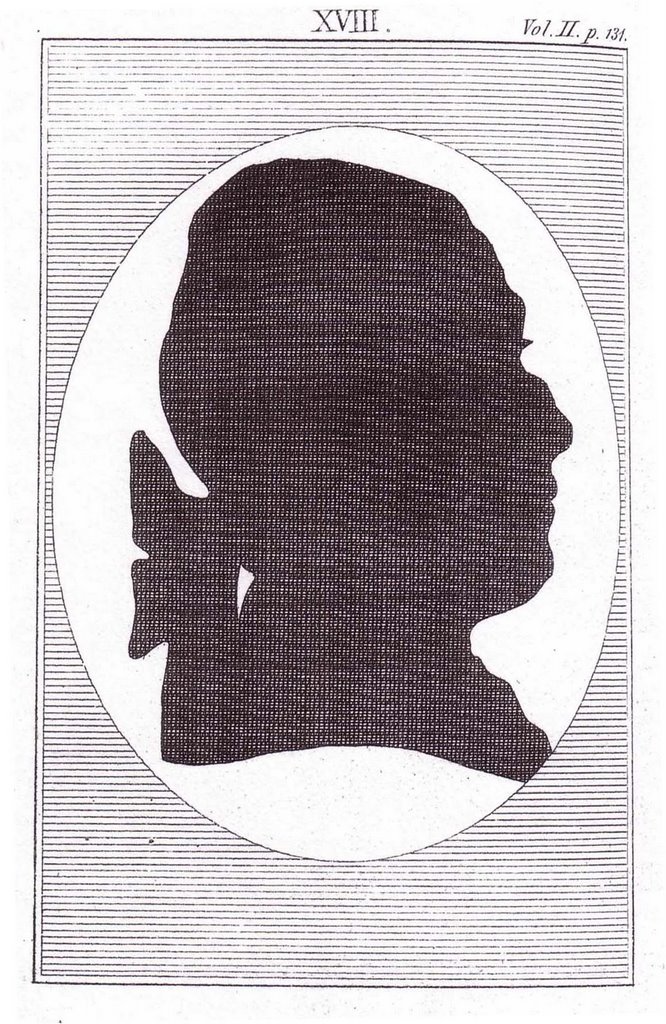
Silhouette from Lavater’s treatise on physiognomy illustrating, “A man of business, with more than common abilities. Undoubtedly possessed of talents, punctual honesty, love of order, and deliberation. An acute inspector of men; a calm, dry, determined judge.”
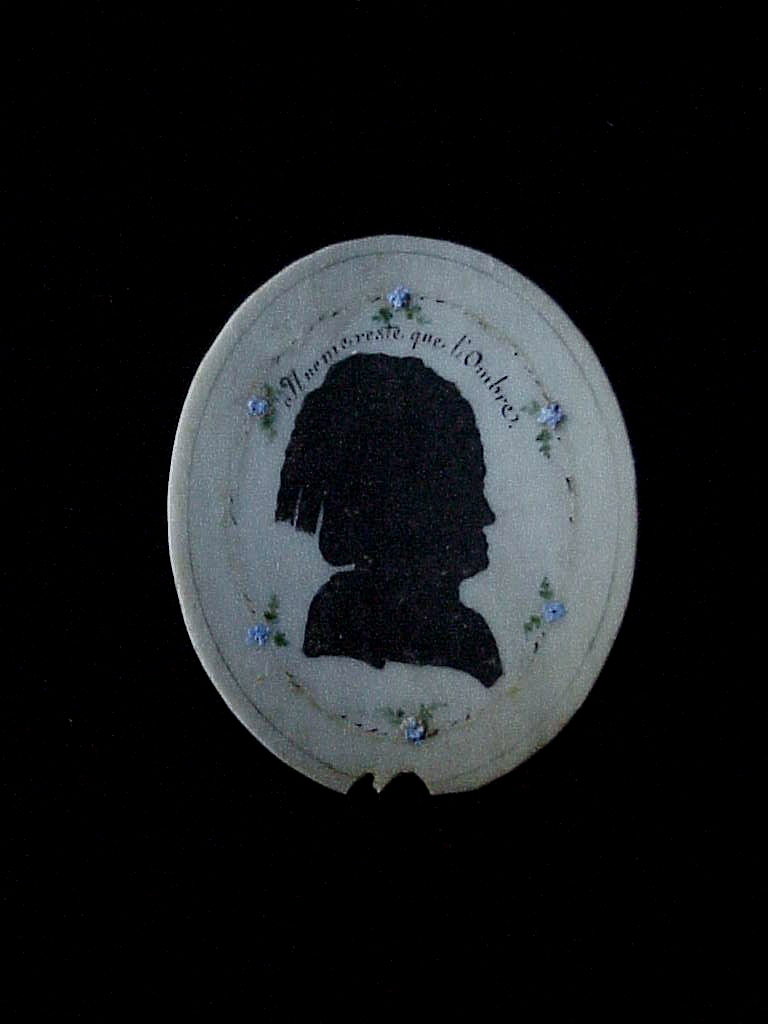
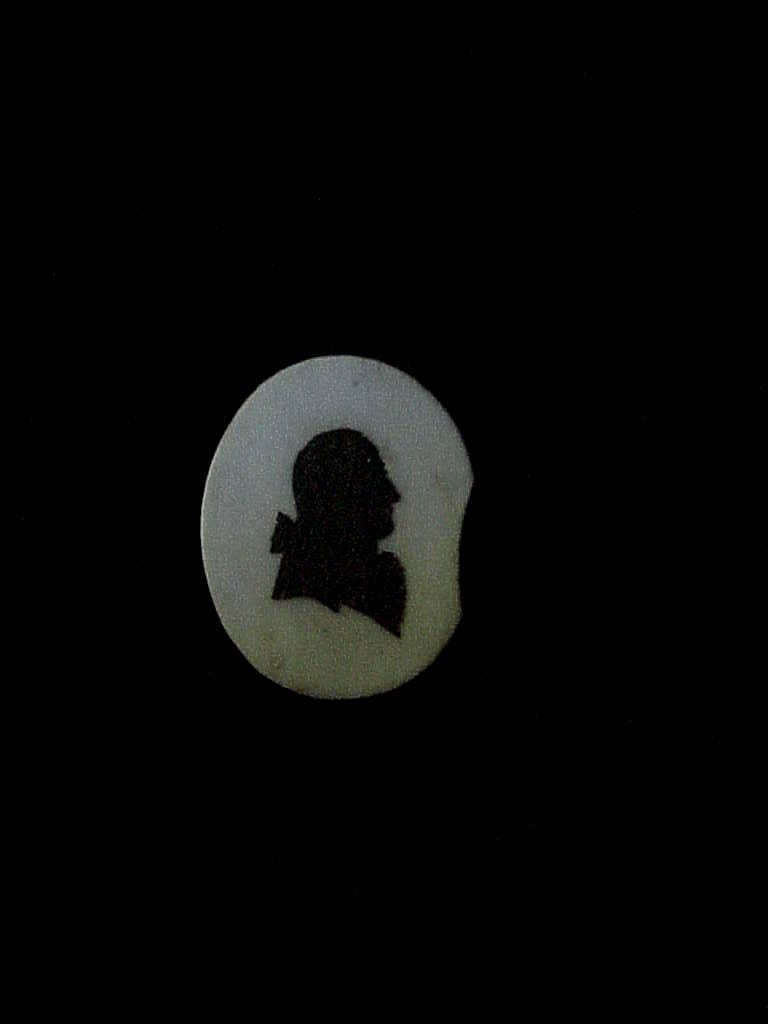
Pair of unframed French mourning silhouettes, circa 1780, preumably representing a husband and wife. Both silhouettes are cut from black paper affixed to ivory and embellished with watercolor. Her silhouette bearing the inscription, "Il ne me reste que l'ombre," or "Only my shade remains," is surrounded by six tiny forget-me-nots.
John Miers (fl. 1760-1810) Silhouette of John Shore Lord Teigenmouth (1751-1834). He served as the Governor General of India from 1793-1797 and was made the First Baron Teigenmouth in the Irish Peerage in 1798. This Miers watercolor on plaster silhouette, c. 1800, is the earliest known portrait of John Shore. Price: $1400


Thomas R. Poole, wax medallion of Lord Teigenmouth, 1818, from the National Portrait Gallery.

George Richmond, watercolor of Lord Teigenmouth, 1832, from the National Portrait Gallery.
John Miers (fl. 1760-1810) Silhouette pair painted on ivory and signed "Miers" under the truncation. Price: $1800


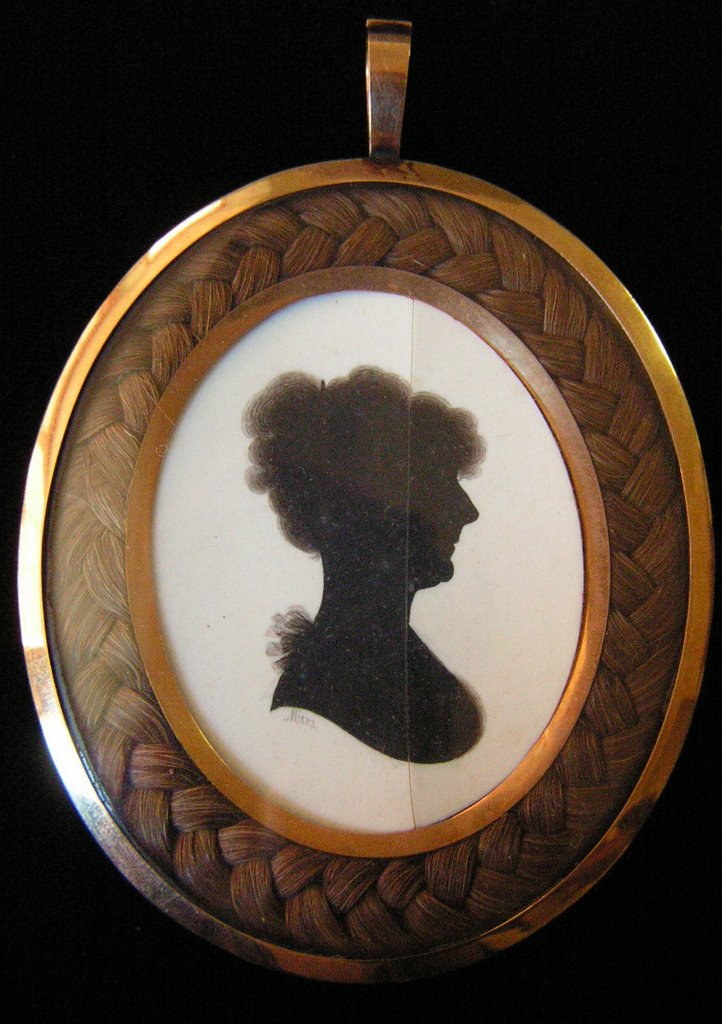
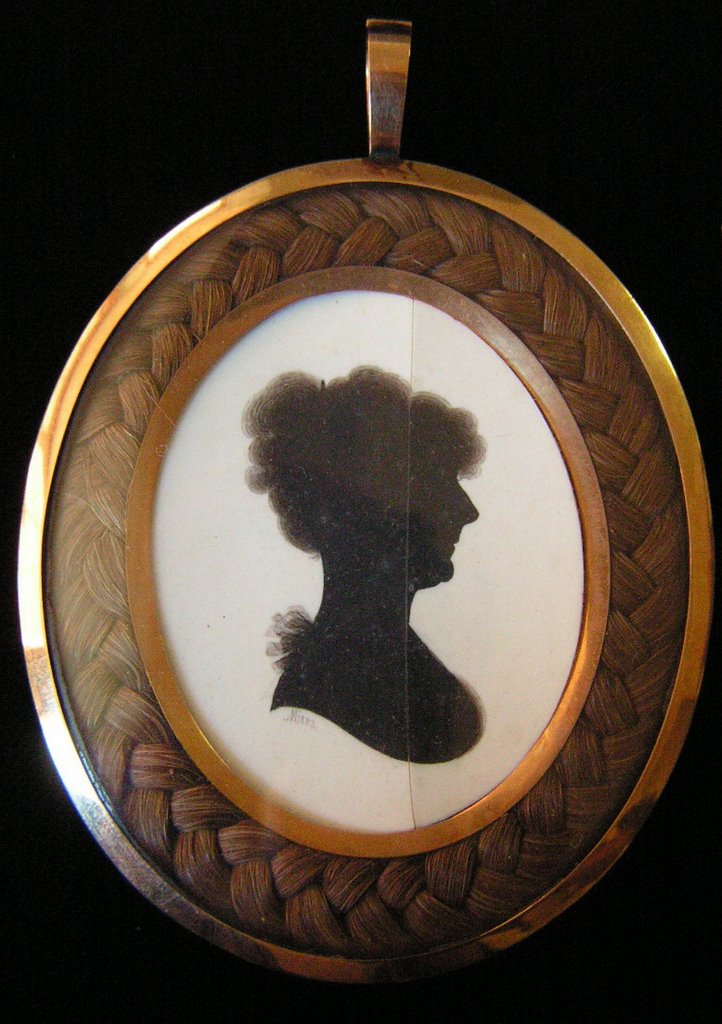
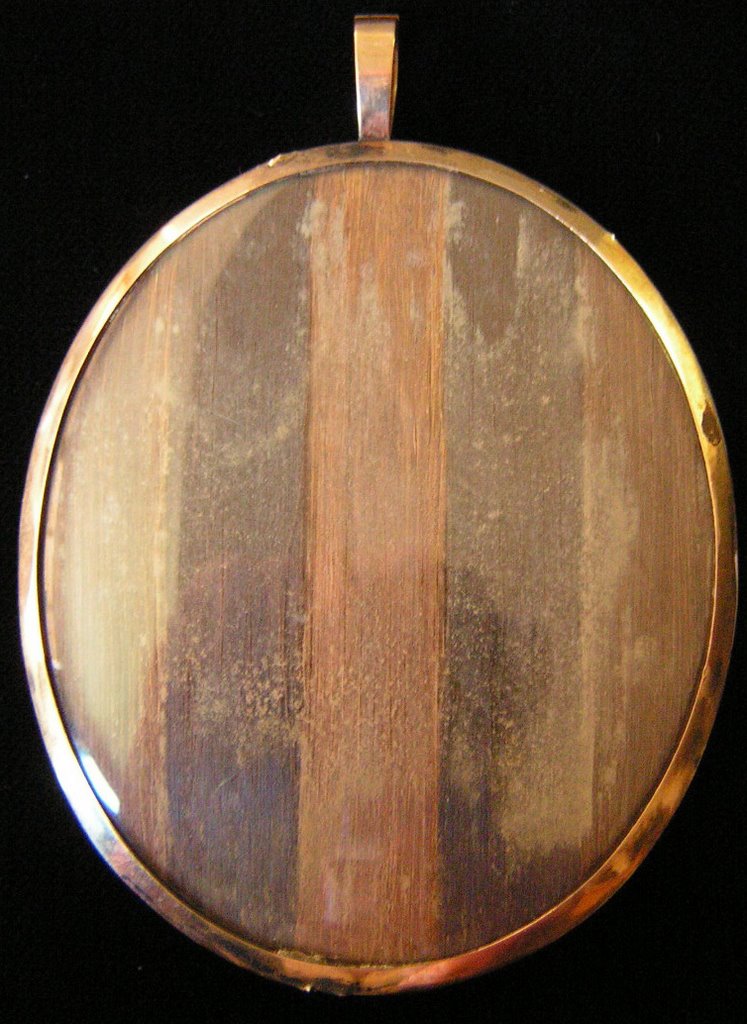
John Miers (fl. 1760-1810) Silhouette painted on plaster and signed “Miers” under the truncation with braided hair surround and hairwork reverse. Unfortunately, cracked vertically. John Miers was the master of delineating the finely detailed diaphanous features of clothing.
J. H. Gillespie (fl. 1810-1838) Profile of English Lady c. 1815-20 bearing only the corner remnants of trade label #2. This profile is the type advertised as, "Likenesses, with the features neatly shaded on black grounds, in imitation of copper-plate busts, at 5s. each." He also offered bronzed silhouettes at 5s. and profiles "shaded in watercolor," that is full color profiles with his trademark blue brown crescent shading along the bottom edges of the miniature, for 7s. 6d. each. Gillespie advertised his work as "likenesses drawn in one minute" with the aid of "several mechanical and optical instruments" including a physiognograph, his version of the popular physiognotrace. Gillespie worked in America in the 1830s and at that time he charged 25 cents for silhouettes, 50 cents for the type of profile pictured below, $1 for bronzed silhouettes, and $2 for "features neatly painted in colors."

Silhouettes
“Shades are the truest representation that can be given of man” – Johann Lavater, 1804Shades, the old name given to silhouettes, became popular after about 1760 and were an outgrowth of the neoclassical revival. Silhouette artists were extremely influenced by both Johann Lavater and classical Greek art. Lavater, the father of the pseudo-science of physiognomy, believed that one’s internal qualities, emotions, intellect, capacity for achievement, and so forth, could be read from a profile of the face especially as a shade. Essentially physiognomy was the “science” of judging a book by its cover, but it was very popular with the producers and consumers of silhouettes. Ancient Greek black figure vases and red figure vases provided additional sources of inspiration and study for artists. For example, both Charles Rosenberg and Jacob Spornberg produced silhouettes in imitation of these silhouette-like vases. Silhouettes were produced on a variety of media including paper, plaster, and ivory.
Silhouette from Lavater’s treatise on physiognomy illustrating, “A man of business, with more than common abilities. Undoubtedly possessed of talents, punctual honesty, love of order, and deliberation. An acute inspector of men; a calm, dry, determined judge.”
Pair of unframed French mourning silhouettes, circa 1780, preumably representing a husband and wife. Both silhouettes are cut from black paper affixed to ivory and embellished with watercolor. Her silhouette bearing the inscription, "Il ne me reste que l'ombre," or "Only my shade remains," is surrounded by six tiny forget-me-nots.
John Miers (fl. 1760-1810) Silhouette of John Shore Lord Teigenmouth (1751-1834). He served as the Governor General of India from 1793-1797 and was made the First Baron Teigenmouth in the Irish Peerage in 1798. This Miers watercolor on plaster silhouette, c. 1800, is the earliest known portrait of John Shore. Price: $1400
Thomas R. Poole, wax medallion of Lord Teigenmouth, 1818, from the National Portrait Gallery.
George Richmond, watercolor of Lord Teigenmouth, 1832, from the National Portrait Gallery.
John Miers (fl. 1760-1810) Silhouette pair painted on ivory and signed "Miers" under the truncation. Price: $1800
John Miers (fl. 1760-1810) Silhouette painted on plaster and signed “Miers” under the truncation with braided hair surround and hairwork reverse. Unfortunately, cracked vertically. John Miers was the master of delineating the finely detailed diaphanous features of clothing.
J. H. Gillespie (fl. 1810-1838) Profile of English Lady c. 1815-20 bearing only the corner remnants of trade label #2. This profile is the type advertised as, "Likenesses, with the features neatly shaded on black grounds, in imitation of copper-plate busts, at 5s. each." He also offered bronzed silhouettes at 5s. and profiles "shaded in watercolor," that is full color profiles with his trademark blue brown crescent shading along the bottom edges of the miniature, for 7s. 6d. each. Gillespie advertised his work as "likenesses drawn in one minute" with the aid of "several mechanical and optical instruments" including a physiognograph, his version of the popular physiognotrace. Gillespie worked in America in the 1830s and at that time he charged 25 cents for silhouettes, 50 cents for the type of profile pictured below, $1 for bronzed silhouettes, and $2 for "features neatly painted in colors."
Wednesday, September 20, 2006
Tribe's tech plan a model program
Tribe's tech plan a model programMark ShafferThe Arizona RepublicSept. 19, 2006 12:00 AM TONALEA - While much of rural Arizona lags in an Internet void, the Navajo Nation is a leader among the nation's tribes in speedy connections.Renda Fowler, community services director for the remote Tonalea chapter east of Tuba City, says it never ceases to amaze her. As cattle graze outside her window and
Saturday, September 16, 2006
EPA whiffs power plant
EPA whiffs power plantProponents argue air is clean; opponents worry about mercurySunday, September 17th 2006By John R. Crane Journal Staff WriterSithe Global officials say the Desert Rock power plant would cap mercury output by at least 80 percent and would set a new standard for pollution controls for other energy facilities."The air, with or without Desert Rock, is getting signifi-cantly
Wednesday, September 13, 2006
New Miss Indian Nations crowned in Bismarck
New Miss Indian Nations crowned in BismarckThe fourteenth Miss Indian Nations is a descendant of Chief Standing Bear of the Ponca Tribe.Ponka-We Vickers, a member of the Ponca Nations of Kansas and the Tohono O'odham Nation, was selected from five nominees Saturday at the United Tribes International Powwow."I'm shocked that I was chosen," Vickers said after being crowned. "But I'm very humbled by
Tuesday, September 12, 2006
Billy earns the Miss Navajo Nation title
Billy earns the Miss Navajo Nation titleBy Natasha Kaye JohnsonDiné BureauJocelyn Billy of Chinle holds back tears of joy as she is crowned Miss Navajo Nation 2006-07 by Miss Navajo Nation 2005-06 Rachel James at the 60th Annual Navajo Nation Fair in Window Rock on Saturday night. Billy graduated from NAU and was crowned Miss Indian NAU while attending school thereWINDOW ROCK — Each year, one Din
Subscribe to:
Posts (Atom)
